Article Details

Case Report
Volume 01, Issue 01 (October–December 2026)

Neglected Constrictive Ring Injury Leading to Thumb Gangrene, Myiasis and Polymicrobial Infection in a Patient with Schizophrenia: A Case Report

Ahmed Al Ghaithi1, Mohamed Fawzy Kandil1* and Nawaf Al Muqaimi2

1Department of Orthopaedic Surgery, Sultan Qaboos University Hospital, Seeb, Muscat, Sultanate of Oman

2Department of Plastic Surgery, Sultan Qaboos University Hospital, Seeb, Muscat, Sultanate of Oman

*Corresponding author: Mohamed Fawzy Kandil, Department of Orthopaedic Surgery, Sultan Qaboos University Hospital, Seeb, Muscat, Sultanate of Oman. E-mail: m.kandil@squ.edu.om.

Received: 03 May 2026; Revised: 18 September 2026; Accepted: 22 September 2026; Published: 20 October 2026

Citation: Al Ghaithi A, Kandil MF, Al Muqaimi N. Neglected Constrictive Ring Injury Leading to Thumb Gangrene, Myiasis and Polymicrobial Infection in a Patient with Schizophrenia: A Case Report. Orthop Surg Case Rep J. October-December 2026; 01(01): 21-26.
Article Image
Abstract

Background: Constrictive ring injuries of the digits are uncommon but potentially devastating conditions that may lead to progressive vascular compromise, digital ischaemia, tissue necrosis, and amputation if diagnosis and treatment are delayed. Advanced presentations may be further complicated by secondary polymicrobial infection and myiasis, particularly in vulnerable patients with impaired insight and self-neglect. Individuals with severe psychiatric disorders are especially susceptible to delayed presentation, resulting in increased morbidity and poorer functional outcomes.
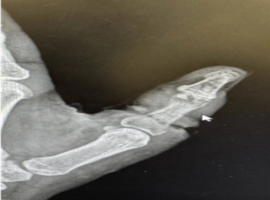
Case Presentation: We report the case of a 32-year-old woman with chronic schizophrenia who presented with a neglected constrictive ring injury involving the left thumb. Owing to delayed presentation and refusal to remove the constricting ring, the injury progressed to irreversible digital ischaemia and gangrene, complicated by wound myiasis and polymicrobial soft tissue infection. Clinical examination demonstrated extensive tissue necrosis distal to the constriction, associated with foul-smelling purulent discharge and visible maggot infestation. Laboratory investigations revealed inflammatory markers consistent with acute infection CRP was 31, while radiographs showed no evidence of osteomyelitis. Following multidisciplinary assessment, the patient underwent urgent surgical management consisting of first metacarpophalangeal joint disarticulation, serial surgical debridement, culture-directed antimicrobial therapy, and delayed wound closure. Microbiological cultures demonstrated polymicrobial infection, including Morganella morganii. The postoperative course was uncomplicated, and satisfactory wound healing was achieved after two weeks of antibiotics following the last surgery.
Conclusion: This case highlights the severe consequences of neglected constrictive ring injuries, particularly in patients with severe psychiatric illness. The coexistence of digital gangrene, myiasis, and polymicrobial infection involving Morganella morganii represents an exceptionally uncommon presentation. Early recognition, prompt surgical intervention, appropriate antimicrobial therapy, and multidisciplinary management including psychiatric care are essential to minimise morbidity and optimise clinical outcomes.

Keywords: Constrictive ring injury; Thumb gangrene; Myiasis; Morganella morganii; Schizophrenia; Polymicrobial infection